

WhatsApp has open rates of over 90%, far more than email. Since September 2025, Klaviyo has offered WhatsApp directly as a channel.[1] But is it really worth the effort? And what does it cost? Here is an overview.
01Why WhatsApp?
- Topic
- Messenger in Europe
- Key point
- transactional and time-critical
WhatsApp is the most widely used messenger in Europe.[1] Open rates are above 90%, while according to Klaviyo a good open rate for email campaigns in 2026 is around 31%.[10] Messages are read within minutes.
Important: WhatsApp works best for transactional and time-critical messages. For newsletters, email remains the better choice.
02Klaviyo + WhatsApp integration
- Topic
- native integration
- Key point
- Meta Business Account
Since September 2025, Klaviyo has offered WhatsApp as a dedicated channel directly in the tool.[1] This means:
- You can build WhatsApp flows directly in Klaviyo[1]
- The same segmentation and triggers as for email[2]
- Central reporting for email, SMS and WhatsApp[1]
Requirement: you need a verified Meta Business Account. You start the connection directly in Klaviyo under Settings → WhatsApp with your Facebook login.[3]
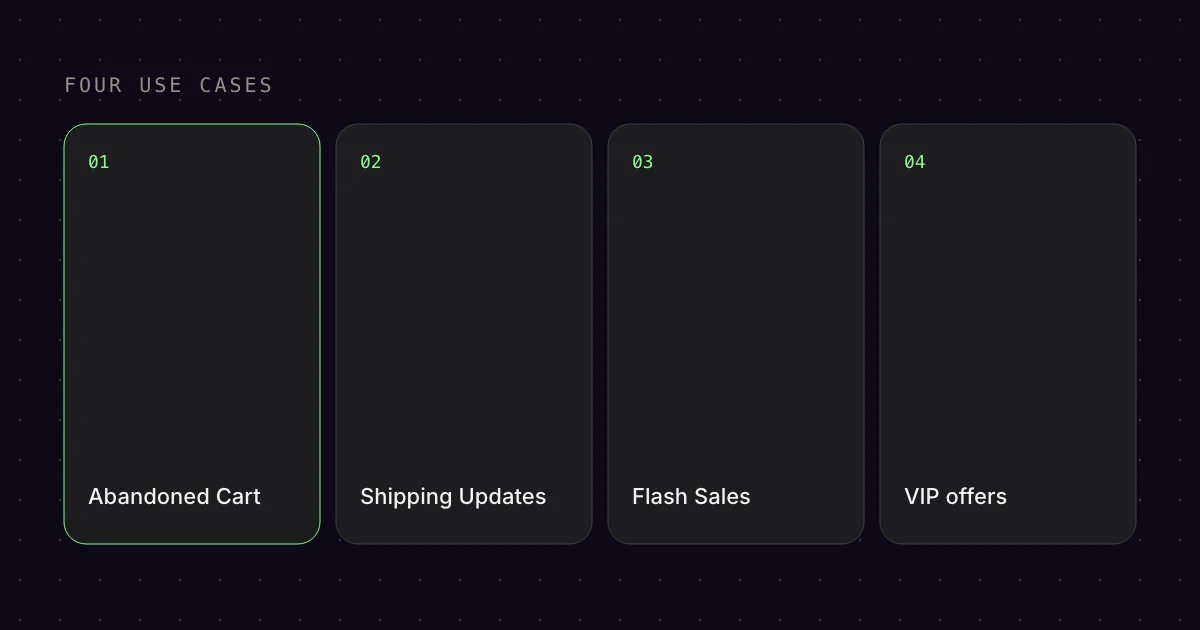
03The 4 most important use cases
- Topic
- four use cases
- Key point
- Abandoned Cart is the classic
1. Abandoned Cart
The classic use case. Someone abandons their purchase and gets a WhatsApp message with their cart 1-2 hours later.[2] The conversion rate is significantly higher than for email Abandoned Cart Flows.
2. Shipping Updates
Shipping confirmations, tracking updates, delivery notifications.[2] Customers want to know where their parcel is. WhatsApp is perfect for this because it is read immediately.
3. Flash Sales
Time-limited offers with urgency. “Today only: 20% off.” This works better via WhatsApp than via email because the message arrives instantly.
4. VIP offers
Exclusive deals for your best customers. More personal, more direct and more premium than a standard email. This works particularly well for high-AOV products.
04How much does WhatsApp marketing cost?
- Topic
- Costs
- Key point
- depends on the country
Since 1 July 2025, WhatsApp has charged per message.[11] This means: you pay for every delivered template message, and the price depends on the category and the country.[11]
Costs vary by country and category: marketing, utility (meaning order and shipping updates)[2] and authentication. Free-form replies within the customer service window are free of charge.[11] Via Klaviyo, a marketing message to Germany costs around 0.22 to 0.26 US dollars and a transactional message around 0.09 to 0.11 US dollars, depending on volume (as of October 2026).[12]
Important: when a customer messages you, a 24-hour window opens. Within it, free-form replies and utility messages are free of charge, while marketing messages are still charged individually.[11]
05GDPR: what is allowed?
- Topic
- Opt-in required
- Key point
- no cold outreach
In the EU, WhatsApp is subject to GDPR.[9] The rules are clear:
- Opt-in required: You may only message contacts who have explicitly signed up for WhatsApp messages (e.g. via a checkbox or a WhatsApp button on your website).
- No cold outreach: You may not send WhatsApp messages to contacts who have not given consent, even if you have their number.[6]
- Opt-out possible at any time: Contacts must be able to unsubscribe easily (e.g. via the
STOPkeyword).[7]
This is not legal advice.
06Is it worth it?
- Topic
- Addition to email
- Key point
- not a replacement for email
WhatsApp is worth it if:
- You send time-critical messages (Abandoned Cart, Shipping, Flash Sales)
- You have an engaged audience that actively uses WhatsApp
- You are willing to invest in opt-in mechanisms (e.g. a WhatsApp pop-up on your website)
WhatsApp is not a replacement for email but an addition. The combination of email (for content, newsletters, longer stories) and WhatsApp (for time-critical, transactional messages) is the strongest.
Conclusion: WhatsApp marketing works if you use it correctly. Highest open rates, native Klaviyo integration, GDPR compliant with opt-in. But: it is not suitable for everything. Use it selectively for transactional and time-critical messages, not as a spam channel.
FAQ
Can you send WhatsApp messages with Klaviyo?
Yes. Klaviyo offers WhatsApp as a dedicated channel. You plan WhatsApp messages in the same flows and campaigns as email and SMS, use the same segments and see the results together with the other channels. Klaviyo distinguishes between marketing, utility and service messages, meaning advertising, order updates and customer service.
What do I need for WhatsApp in Klaviyo?
You need a Facebook account, a Meta business account with a WhatsApp Business profile and your own phone number that is not your SMS sender number. If the number is already registered with WhatsApp, you have to migrate it. Klaviyo strongly recommends verification with Meta, which can take up to 30 days directly with Meta.
Do I need consent for WhatsApp marketing?
Yes. Under Meta’s rules, you may only message people who have agreed to receive messages from your business. When they opt in, it must be clear which business the messages come from. The laws of your country also apply. Klaviyo offers a double opt-in where contacts confirm with a keyword such as YES.
How do contacts unsubscribe from WhatsApp?
Contacts simply send an opt-out word such as STOP, UNSUBSCRIBE, CANCEL, END or QUIT. Klaviyo then removes the WhatsApp consent and sends a confirmation. By default, it is enough for the word to appear anywhere in the message. Meta requires you to respect every opt-out, no matter how it arrives.
What is WhatsApp good for in an online shop?
It works best for time-critical messages: cart reminders, shipping and delivery updates, short promotions and offers for your best customers. For newsletters and longer stories, email remains the better choice. WhatsApp is an addition and not a replacement, so use it selectively and not as a spam channel.
Sources
- Klaviyo: “Introducing Klaviyo WhatsApp Marketing Tool: New Product Launch”, published 24 Sep 2025. https://www.klaviyo.com/blog/klaviyo-whatsapp-product-launch (accessed 17 Oct 2026)
- Klaviyo: “WhatsApp Tools for Marketing & Customer Service”, undated. https://www.klaviyo.com/products/whatsapp (accessed 17 Oct 2026)
- Klaviyo Help Center: “How to connect your WhatsApp Business account to Klaviyo”, updated 27 Mar 2026. https://help.klaviyo.com/hc/en-us/articles/40111819732635 (accessed 17 Oct 2026)
- Klaviyo Help Center: “Verify your Meta Business Portfolio for WhatsApp”, updated 27 Mar 2026. https://help.klaviyo.com/hc/en-us/articles/40116148219163 (accessed 17 Oct 2026)
- Meta for Developers: “Get opt-in for WhatsApp”, undated. https://developers.facebook.com/documentation/business-messaging/whatsapp/getting-opt-in (accessed 17 Oct 2026)
- WhatsApp Business (Meta): “WhatsApp Business Messaging Policy”, updated 23 Sep 2026. https://whatsappbusiness.com/policy/ (accessed 17 Oct 2026)
- Klaviyo Help Center: “About WhatsApp keywords”, updated 27 Mar 2026. https://help.klaviyo.com/hc/en-us/articles/42138426687003 (accessed 17 Oct 2026)
- Klaviyo Help Center: “About WhatsApp double opt-in”, updated 27 Mar 2026. https://help.klaviyo.com/hc/en-us/articles/42138701884827 (accessed 17 Oct 2026)
- EUR-Lex, Amt für Veröffentlichungen der EU: “Verordnung (EU) 2016/679 (Datenschutz-Grundverordnung)”, undated (Official Journal of 4 May 2016). https://eur-lex.europa.eu/legal-content/DE/TXT/HTML/?uri=CELEX:32016R0679 (accessed 17 Oct 2026)
- Klaviyo: “2026 Email Marketing Benchmarks by Industry”, undated. https://www.klaviyo.com/products/email-marketing/benchmarks (accessed 17 Oct 2026)
- Meta for Developers: “Pricing on the WhatsApp Business Platform”, undated. https://developers.facebook.com/documentation/business-messaging/whatsapp/pricing (accessed 17 Oct 2026)
- Klaviyo: “Klaviyo Pricing | Start Free with Email & SMS (Preisrechner Mobile messages)”, undated. https://www.klaviyo.com/pricing (accessed 17 Oct 2026)
This article is by Emailfy. We set up Klaviyo for Shopify stores, which is exactly what we write about here. How we work: Editorial guidelines.