

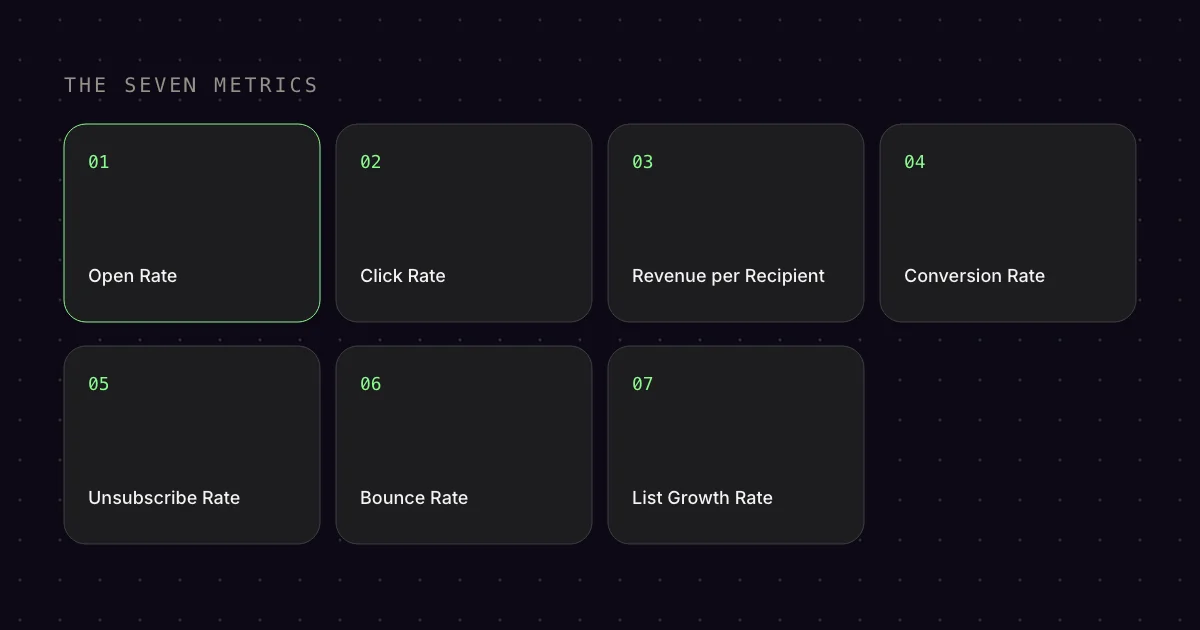
Without KPIs, you are flying blind. Which metrics should you track? What are good benchmarks? And what does the Klaviyo dashboard show you? Here is an overview of the most important email marketing metrics for online shops.
01Open Rate
- Measures
- Opens
- Key point
- no longer as reliable
What it is: The percentage of recipients who opened your email.[5]
E-commerce benchmark: around 31% (Campaigns), around 32% (Flows) in the 2026 Klaviyo average, with the top 10% at about 45%[1]
What influences the open rate:
- Subject line and preheader
- Sender name (recognisable names perform better)
- Send time (test different times)
- List hygiene (inactive contacts drag the rate down)
Important: Since iOS 15 Mail Privacy Protection, many opens are artificially inflated.[3] The open rate is no longer as reliable as it used to be. The click rate is becoming more important.
02Click Rate (CTR)
- Measures
- Clicks on links
- Key point
- shows real interest
What it is: The percentage of recipients who clicked a link.[5]
E-commerce benchmark: 1.69% (Campaigns), 5.58% (Flows) in the 2026 Klaviyo average, with the top 10% reaching 3.38% and 10.48% respectively[1]
Why it matters more than the open rate: Clicks show real interest. Someone who clicks is closer to buying than someone who only opens.
What improves the click rate:
- A clear, visible CTA (call to action)
- Relevant content (segmentation helps)
- Mobile-optimised design (many people read on their phone)
03Revenue per Recipient (RPR)
- Measures
- Revenue per recipient
- Key point
- much higher for flows
What it is: The average revenue per delivered email.[10]
Why it matters: The ultimate e‑commerce metric. Open rate and click rate are nice to have. Revenue per recipient shows whether your emails make money.
Formula: attributed revenue divided by the number of delivered emails[10]
Example: 10,000 emails are delivered and generate €5,000 in revenue → RPR = €0.50
Flows vs. Campaigns: Flows have a much higher RPR because they are triggered and personalised.[2] An Abandoned Cart Flow can reach an RPR of €2-5, while campaigns are at €0.10-0.50.
04Conversion Rate
- Measures
- Purchases after the email
- Key point
- 5-day attribution
What it is: The percentage of recipients who bought something after the email.
E-commerce benchmark: around 0.16% (Campaigns), around 2.1% (Flows) in the 2026 Klaviyo average, with the top 10% reaching 0.36% and 4.3% respectively[1]
Attribution Window: Klaviyo typically tracks conversions within 5 days of the email being sent.[6] Someone opens your email today and buys tomorrow → the purchase is attributed to the email.
05Unsubscribe Rate
- Measures
- Unsubscribes
- Key point
- below 0.3% is good
What it is: The percentage of recipients who unsubscribe.[5]
Benchmark: Below 0.3% is good. For us, anything above 0.5% is a warning sign, and that is our stricter recommendation. Klaviyo only advises taking action above 1%, and between 0.3% and 1% it sees room for improvement.[4]
When does the unsubscribe rate rise?
- Too many emails in a short time
- Irrelevant content
- Overly aggressive selling
What should you do? Reduce the frequency, improve segmentation, offer a preference centre (“How often do you want to hear from us?”).
06Bounce Rate
- Measures
- Undelivered emails
- Key point
- below 1% is good
What it is: The percentage of emails that could not be delivered.
2 types:
- Hard Bounce: Invalid email address (automatically suppressed by Klaviyo)[7]
- Soft Bounce: Temporary problem (e.g. mailbox full)
Benchmark: Below 1% is good.[4] Above 2%, you should review your list hygiene.
07List Growth Rate
- Measures
- List growth
- Key point
- if you don’t grow, you shrink
What it is: How fast is your email list growing?
Formula: (New Subscribers - Unsubscribes - Bounces) / total list × 100
Why it matters: Every list naturally loses contacts (unsubscribes, inactive addresses). If you are not growing, you are shrinking.
How to improve list growth:
- Pop-ups with an incentive (e.g. 10% off)
- Exit-intent pop-ups
- Post-purchase opt-in (invite customers to the newsletter after their purchase)
08Flows vs. Campaigns: the most important difference
- Measures
- Flows versus campaigns
- Key point
- Flows as the revenue engine
Flows and campaigns have completely different KPIs:
- Flows: Slightly higher open rate (around 32%), higher click rate (5.58%)[1], much higher RPR (€2-5). Why? Because they are triggered and personalised.
- Campaigns: Slightly lower open rate (around 31%), lower click rate (1.69%)[1], lower RPR (€0.10-0.50). Why? Because they go to the entire list.
Conclusion: Flows are your revenue engine. Campaigns are for engagement and brand building.
09Klaviyo dashboard: where do you find the KPIs?
- Measures
- Where to find the KPIs
- Key point
- Use custom reports
Klaviyo shows all the important metrics in the dashboard:
- Overview Dashboard: Total revenue, RPR, number of emails sent
- Campaign Analytics: Open rate, click rate, revenue, conversion rate per campaign[5]
- Flow Analytics: RPR, conversion rate, revenue per flow
- Segment analysis: In the custom report
Campaign Performance Report, you group by list or segment and see which segments perform best.[8]
Tip: Use custom reports to track exactly the metrics that matter for your business.[8]
Conclusion: The most important KPIs for e‑commerce are revenue per recipient and conversion rate. Open rate and click rate are indicators, but in the end what counts is this: does your email marketing generate revenue? Klaviyo shows you all the metrics in the dashboard. Use them to optimise continuously.
FAQ
Why is the open rate no longer reliable?
Since iOS 15, Apple Mail preloads the images in an email when Mail Privacy Protection is turned on, including the invisible tracking pixel. As a result, Klaviyo counts opens that never happened, and the open rate rises artificially. Google itself does not measure open rates. So focus more on clicks and revenue.
What is a good email click rate?
In the 2026 Klaviyo average, 1.69% of recipients click a link in a campaign, and the top 10% reach 3.38%. For flows, the average is 5.58%, with the top 10% reaching 10.48%. Campaigns between 1 and 3% and flows between 5 and 10% are therefore realistic targets.
What bounce rate is still acceptable?
Klaviyo considers a bounce rate below 1% healthy, between 1 and 2% there is room for improvement, and above 2% you should take action. Klaviyo automatically suppresses invalid addresses with a hard bounce. For soft bounces, this only happens once an address has been undeliverable more than seven times in a row.
What spam complaint rate is allowed at Gmail?
Google requires all senders to keep their spam rate below 0.3% and recommends staying consistently below 0.1%. It is measured in Google Postmaster Tools. Klaviyo considers values below 0.01% healthy and advises taking action from 0.05%, for example by excluding inactive contacts.
How long does Klaviyo attribute a purchase to an email?
For accounts created after 9 October 2024, the default window for emails is 5 days. Only recipients who opened or clicked the email are counted. Klaviyo attributes the purchase to the message the recipient last engaged with. You can change the window in the settings.
Sources
- Klaviyo (Blog): “Email marketing benchmarks 2026: open rates, click rates and conversion rates by industry”, updated 24 Feb 2026. https://www.klaviyo.com/uk/blog/email-marketing-benchmarks-open-click-and-conversion-rates (accessed 17 Oct 2026)
- Klaviyo: “2026 email marketing benchmarks by industry”, undated. https://www.klaviyo.com/products/email-marketing/benchmarks (accessed 17 Oct 2026)
- Klaviyo Help Center: “How to identify iOS15 Mail Privacy Protection opens”, updated 5 Aug 2025. https://help.klaviyo.com/hc/en-us/articles/4416791883163 (accessed 17 Oct 2026)
- Klaviyo Help Center: “Getting started with email deliverability monitoring and performance metrics”, updated 10 Mar 2026. https://help.klaviyo.com/hc/en-us/articles/115000201131 (accessed 17 Oct 2026)
- Klaviyo Help Center: “Understanding available campaign analytics”, updated 10 Feb 2026. https://help.klaviyo.com/hc/en-us/articles/115005258568 (accessed 17 Oct 2026)
- Klaviyo Help Center: “Understanding message conversion tracking”, updated 26 Mar 2026. https://help.klaviyo.com/hc/en-us/articles/115005248128 (accessed 17 Oct 2026)
- Klaviyo Help Center: “Understanding bounced emails in Klaviyo”, updated 13 Feb 2026. https://help.klaviyo.com/hc/en-us/articles/115005250408 (accessed 17 Oct 2026)
- Klaviyo Help Center: “How to build a campaign performance report”, updated 27 Jan 2026. https://help.klaviyo.com/hc/en-us/articles/360047022912 (accessed 17 Oct 2026)
- Gmail Help (Google): “Email sender guidelines”, undated. https://support.google.com/mail/answer/81126 (accessed 17 Oct 2026)
- Klaviyo Help Center: “How to calculate revenue per recipient”, updated 6 Aug 2025. https://help.klaviyo.com/hc/en-us/articles/360034724572 (accessed 17 Oct 2026)
This article is by Emailfy. We set up Klaviyo for Shopify stores, which is exactly what we write about here. How we work: Editorial guidelines.